
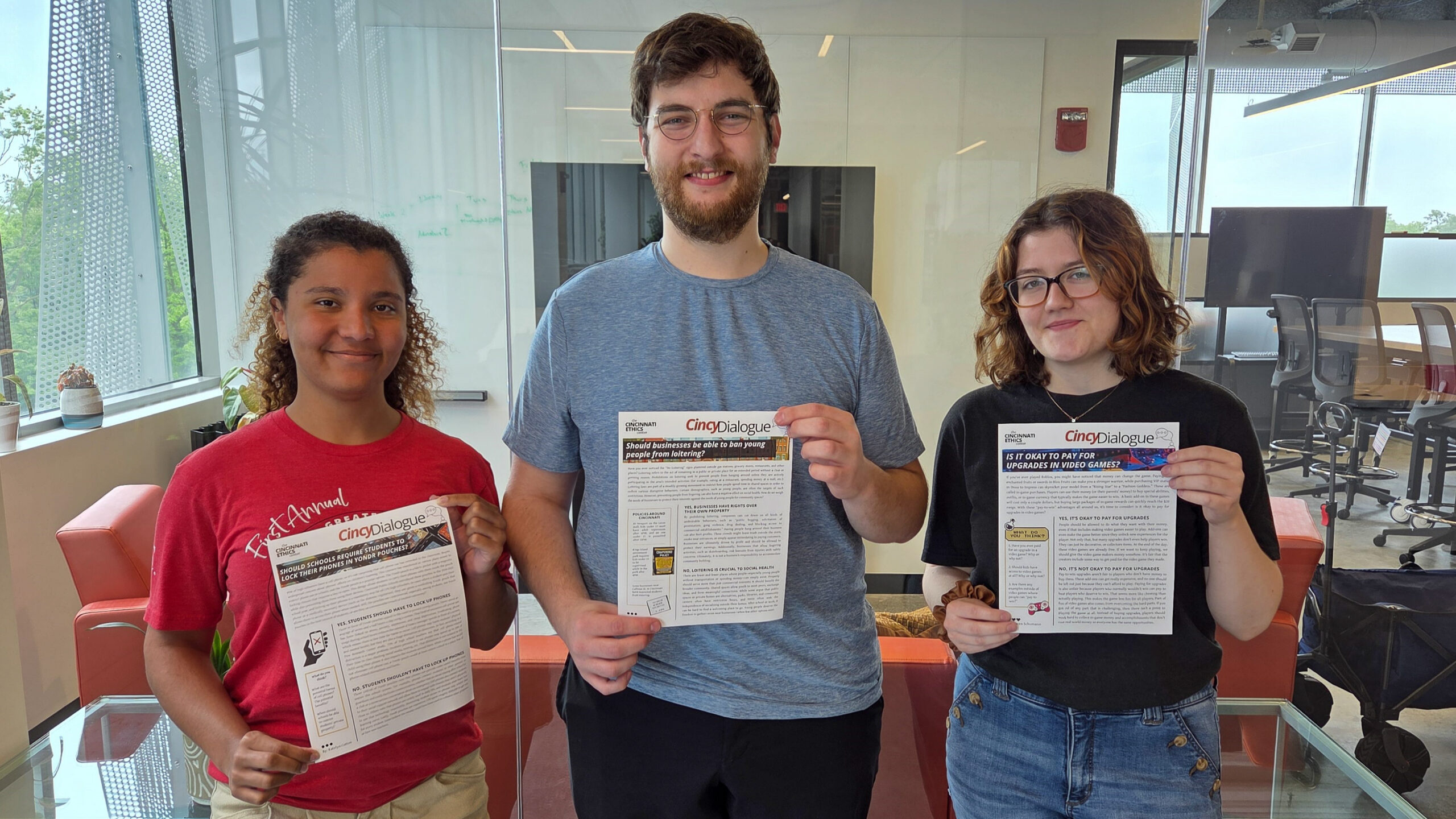
When teachers bring Cincy Dialogue materials into their classrooms, students see thoughtfully crafted ethical questions, engaging discussion prompts, and accessible background information designed to spark meaningful conversations. Supporting the development of these resources are Cincinnati Ethics Center (CEC) undergraduate interns who work alongside Christina Baulch, CEC’s Director of K-12 Educational Programs.
As part of their internship experience, students research current issues, write ethics explainers, and help create classroom-ready materials that support Cincy Dialogue’s mission of helping young people explore challenging questions through discussion, critical thinking, and respectful engagement with differing viewpoints.
The process gives interns an opportunity to strengthen their own research and communication skills while helping local educators introduce complex topics in ways that are relevant and engaging for students.
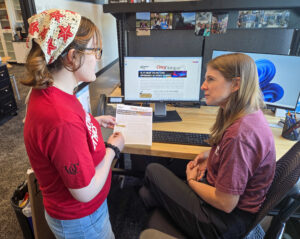
For undergraduate intern Gwendolyn, the work combines research, learning, and writing.
“I enjoyed the writing process because it allowed me to research a wide range of issues,” Gwendolyn said. “Some of my Cincy Dialogue topics were ethical dilemmas that I was well versed on, but others were learning opportunities for me.”
When selecting topics, Gwendolyn focuses on issues that are meaningful to young people and relevant to the Cincinnati community. She believes students engage more deeply when ethical questions connect to their own experiences and surroundings.
“Choosing topics that students encounter in their hometowns and schools helps them add context to challenging ideas,” she said. “That personal connection can really strengthen the students’ arguments and help them dig deeper into why they feel something is right or wrong.”
Gwendolyn hopes students come away understanding that ethics extends far beyond the classroom.
“I hope the students learn that ethics isn’t just a thought experiment,” she said. “We all have to make choices based on right and wrong every day.”
Fellow intern Kyle approaches topic selection through a similar lens, drawing inspiration from issues affecting Cincinnati communities and from conversations taking place both online and in everyday life.
Topics he has explored include food waste, youth access to businesses, and student privacy in an increasingly digital world. Researching these issues often reveals a level of complexity that is not immediately apparent.
“When I dig into the details, I find that these tensions aren’t as one-sided as they appear,” Kyle said.
For Kyle, one of the most important goals of ethics education is encouraging curiosity and openness to new perspectives.
“It’s easy enough to choose a side in a debate, but I think it’s really important for us to stay excited to learn new perspectives,” he said. “It’s more difficult to take a step back and consider compelling arguments from the contrasting perspective.”
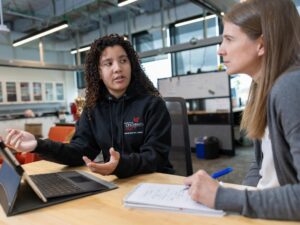
The long-term impact of ethics education can also be seen through Kate’s journey with the Cincinnati Ethics Center. As a student at Walnut Hills High School, she was part of the team that won the inaugural Greater Cincinnati Regional High School Ethics Bowl championship. Years later, she helped support the development of educational resources for younger students through Cincy Dialogue.
Since graduating from Walnut Hills, Kate became the first Marian Spencer Scholar to earn a bachelor’s degree from the University of Cincinnati and is now pursuing a master’s degree in political science while preparing for law school. Her path reflects the kind of lasting engagement the Cincinnati Ethics Center hopes to inspire—students who not only participate in thoughtful discussions but continue applying those skills throughout their academic and professional lives.
Having experienced ethics education firsthand, Kate understands the value of helping younger students explore complex questions, consider multiple perspectives, and develop the confidence to express and defend their ideas.
Under Christina’s leadership, the Cincy Dialogue program continues to expand opportunities for students and teachers to engage with timely issues in meaningful ways. By involving undergraduate interns in the development process, the Cincinnati Ethics Center not only provides valuable experiential learning opportunities for UC students but also strengthens the resources available to educators throughout the region.
From researching local issues to creating classroom discussions that encourage empathy, curiosity, and critical thinking, these students are helping bring ethics education from campus to classroom—one conversation at a time.